Why I’m a Children’s Priest
On February 1st, 2020, just a month before the global pandemic hit, I began a new job as the “Director of Children’s Spiritual Formation” at my church, St. Mary of Bethany, an ecumenical, eucharistic community here in Nashville. At the time, I was invited to write the job description and to pick whatever title I felt comfortable with.
“I am definitely not a pastor,” I said to my priest every time we talked about what the job could look like for me.
I just wanted to curate materials, approve curriculum, and facilitate. I’d been writing music and curriculum for children professionally for a decade, so I felt this was a good role for me.
I couldn’t (and wouldn’t) have taken the job if I had to provide children with easy answers, or any answers at all, especially since I question so much myself. But our children’s curriculum was from Godly Play, a methodology for engaging with scripture that emphasizes meaning-making and gives children tools to process their own existential wondering in ways that are not didactic, prescriptive, or moralistic.
A lot of how we have learned to process and wonder together as a faith community comes directly from Godly Play. We tell the stories from scripture, but we don’t give answers, practical application, or even suggestions for what that scripture or that particular story is “supposed” to mean. We say, “I wonder…” a lot, and we ask questions that help give language to the faith and spirituality that children are already experiencing as whole human beings.
We did not get to practice this wondering together in person for very long, because four weeks after my job began, we went under lockdown for COVID precautions. Surprisingly, I found a lot of joy in writing weekly emails to stay connected to our families. These emails felt more and more like little sermons—not in the way I had always thought sermons were supposed to be, but more like noticing what was happening around me and writing in a way that I hoped was helpful.
My priest started saying things like, “That was so pastoral.” And I would roll my eyes a little, because growing up, I thought a pastor looked a certain way: a man who sat in a big office full of books, handing out answers for everyone’s questions, delivering forty-five-minute sermons, and being naturally very academic.*
I did not and do not fit many of these categories. My gender instantly disqualified me, and I had never felt called to the mission field or to “share the gospel”—or at least, not the Gospel according to Vacation Bible School.
With a large community of children and no in-person church in sight, I began recording videos for the kids to watch every week, featuring the thoughtful stories from Godly Play. I suddenly felt like a mystic Miss Rachel, which was definitely not in the job description I had imagined, but even quarantined with a video camera, those stories began to form me.
Then there was the day I was recording the Godly Play story of baptism, where the storyteller pours water onto an actual baby doll and anoints her head with oil, and everything changed.
Later, I would joke that it was pandemic loneliness getting to me, but in that moment, when I made the cross on her little plastic head and said the words, “You are sealed by the Holy Spirit in baptism and marked as Christ’s own forever,” I lost it—tearing up all by myself, in front of my iPhone.
I don’t know if that was the moment I knew, or if it was just one breadcrumb on the trail I saw beginning to form behind and before me, but I felt the tug toward a calling I hadn’t ever believed was available to me. This was, in fact, the moment that set me on the path toward divinity school, and ultimately, ordination to the priesthood.
Becoming a Priest for the Sake of Children
So many folks in ministry find themselves in youth or children’s ministry as a stepping stone to “real” ministry with adults. So many children’s pastors are actually overburdened, burnt-out volunteers (usually women) with no formal training or support.
I knew from the moment I felt the call to be a “Children’s Priest” that part of that calling was to invest time, money, and energy into a robust theological education. Adults are not the only ones who deserve qualified pastors. Children deserve spiritual care that is informed and serious, even when our lessons are playful. And so children led me to divinity school, where I researched and wrote about the ethics of prayer and spiritual formation with children.
I also knew ordination was important because I wanted little girls in my Godly Play circle to see a woman wearing a collar and to have a different experience growing up than I did—one where they could envision themselves in church leadership if they ever wanted to pursue that path. And the office of a priest is a serious one, with years of prayer, discernment, and the support of the diocese and Bishop, as well as my entire church community, to see it to fruition. Children deserve this level of integrity. I’m not saying you need formal ordination to minister to children, but I am saying that children are worthy of faith leaders who take their spiritual formation seriously.
The featured photo is me baptizing my first real baby after becoming ordained as a priest. It’s no secret that I’m a bit of an emoter, and my husband teasingly said folks should place bets over who would cry more, me or the baby.
But I didn’t cry at all. I just felt immense joy along with the entire congregation who giggled and “awed” at his every movement and coo. At three months old, this little baby boy was warm and heavy in my arms, and I was nervous I might drop him or forget something important. But once we began, it felt as natural as play.
As the community promised to surround him with love, I told them that part of their job would be to remind him of the light of his baptism—the light that can never go out, even when he cannot see it himself.
These promises we make to children take their bodies, their stories, and their belonging seriously. It’s my favorite part of the baptism sacrament and the Baptismal Covenant. Part of that promise, for me, is continuing to be a children’s pastor who actually takes them seriously and treats them with the dignity that all people deserve.
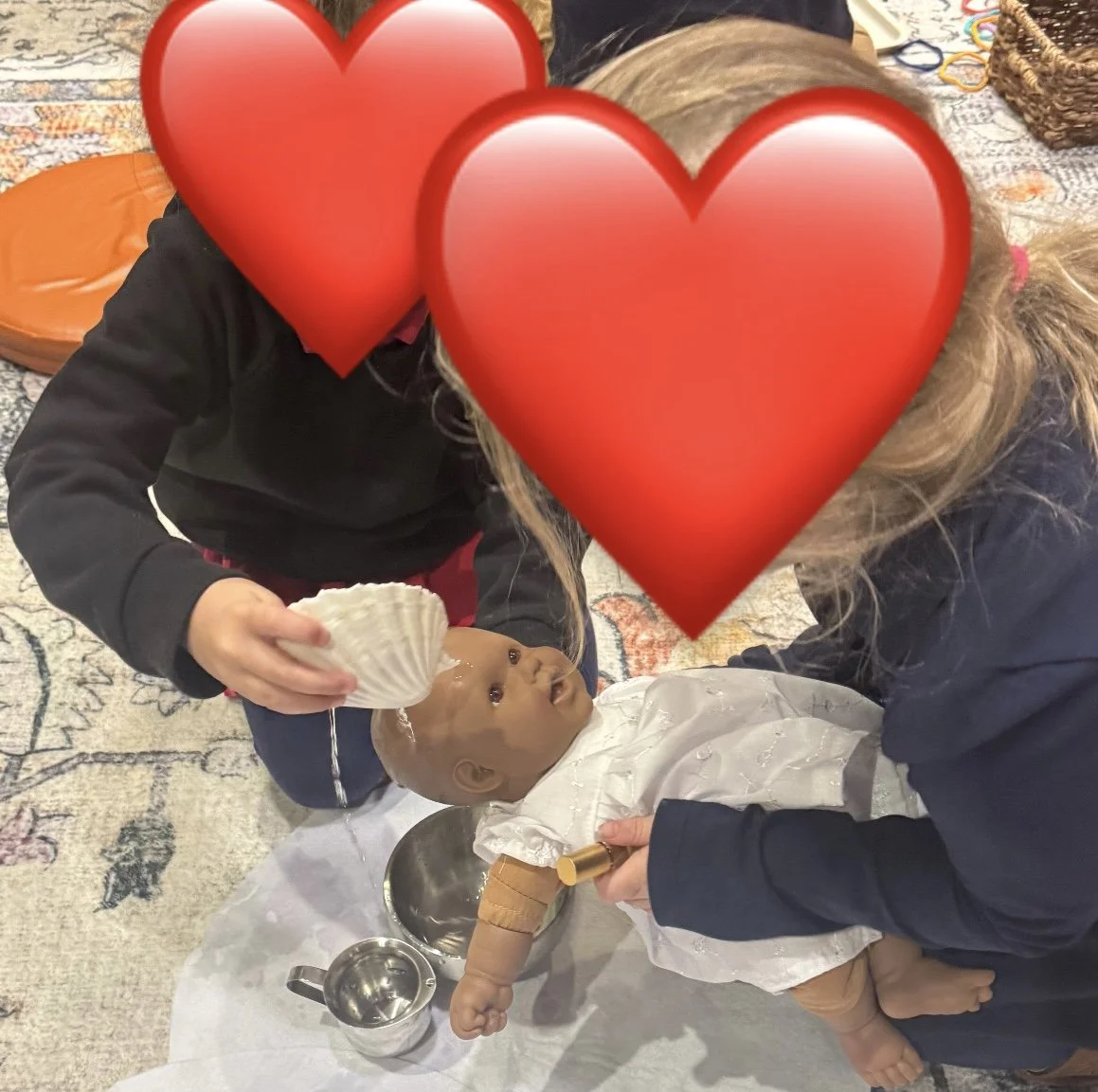
Two little ones hold the baby doll—one pours water on her head with the shell, the other holds the vial of oil.
Recently, I taught a group of four-year-olds the story of baptism. The kids are always amazed at the materials chosen to tell the story. A bowl of water. A lit candle.
“Is that REAL water?!” one child asked. And then I heard whispers as word spread around the circle: “It’s real, it’s real!” they squealed with delight.
Afterward, I watched two little girls baptize the baby doll** together, pouring the very real water over her head with a real shell and anointing her with real oil. One kiddo drew a heart on his own hand with the oil, mimicking a practice we have at the end of Godly Play each week, where they receive a blessing.
I wonder what these precious ones will keep from these days. What will they remember? Not all of them will be baptized or even participate in organized religion, and that’s okay. But maybe when they splash their fingers in cool water or catch a whiff of sweet-smelling fragrance, they’ll remember deep in their bones that they are beloved, worthy, and inherently good—full stop.
The last few words of our Baptismal Covenant, which the congregation is invited to remember and promise at every baptism, are:
“Will you strive for justice and peace among all people, and respect the dignity of every human being?”
“I will, with God’s help.”
May we be adults who keep our promises.
May that inform the world we create for the vulnerable children among us.
And may we all, with God’s help, respect the dignity of children as the full human beings they are.
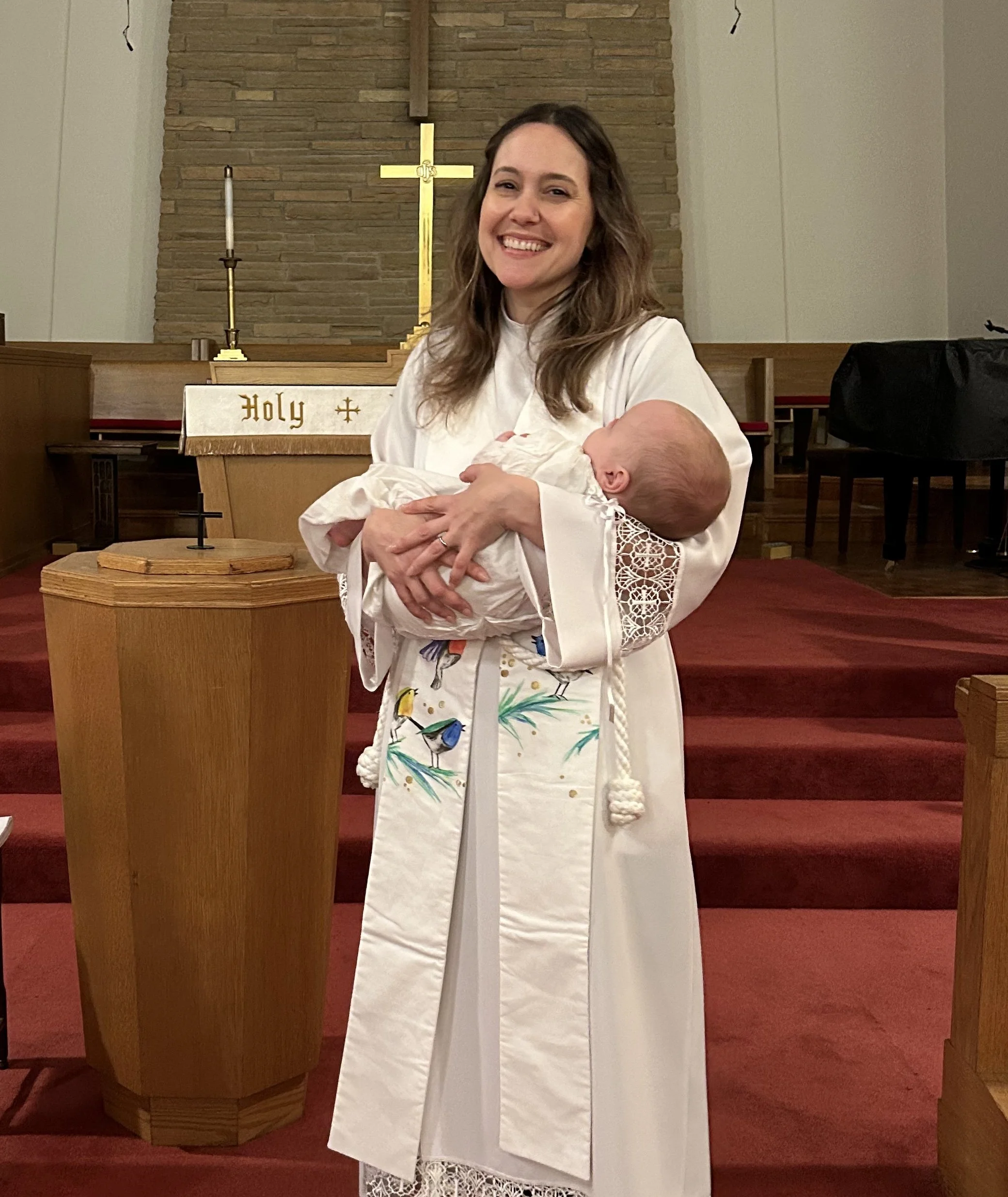
My first baptism after ordination.
*Joke’s on me, because I loved school so much, I’m not sure I won’t just keep going.
**A doll that a group of four-year-olds named “Amy,” which makes me giggle because it is not 1985 anymore.